Background and Martial Arts Journey of Tracy D. Corder Sensei
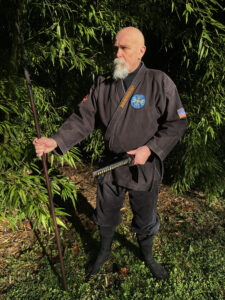
Tracy D. Corder, Sensei, was born in 1962 in a small town in the Midwest. In the late 1960s, he relocated to Tucson, Arizona, where he spent his formative years. During this time, Corder engaged in activities such as Boy Scouts, survival training, watching martial arts movies, and exploring his interest in electronics.
Early Interest and Training
After graduating from high school in 1981, Corder Sensei was unable to join any branch of the Armed Services due to a childhood history of asthma. Instead, he chose to pursue the study of martial arts. His training encompassed a wide variety of disciplines, including Hwarang Do, Tae Kwon Do, Kenpo Kung Fu, Kenpo Karate, Kung Fu, Shorin-Ryu Karate, Ju-Jutsu, Ninjutsu, and Chin-Na, among others.
Transition to Traditional Martial Arts
Seeking a martial art style that emphasized tradition over competition, Corder Sensei moved to Federal Way, Washington in 1989. There, he joined Genbukan Ninpo Bugei and established his own dojo/group under the guidance of licensed Ninpo Taijutsu instructors, Grandmaster Shoto Tanemura Sensei and Shibu-cho Chadwick Minge Sensei.
Achievements and Responsibilities
Corder Sensei was honored with the title of Dojo-cho and achieved Shodan rank in Ninpo Taijutsu and Nidan rank in Jujutsu from the Genbukan Ninpo Bugei and Kokusai Jujutsu Renmei organizations. At that time, earning DAN (black belt) levels required mastery of more than 70 techniques, whereas today, these organizations require only 9 to 18 techniques per Dan level, depending on the program. This recognition brought with it significant responsibility to uphold the traditions and guidelines of these martial arts, creating a good foundation.
Continued Study and Foundation of Kogen Ninpo
Corder Sensei dedicated a decade to studying with the Genbukan Ninpo Bugei and Kokusai Jujutsu Renmei organizations. In 2005, he experienced an involuntary separation from both organizations. Nevertheless, he continued his studies in Ninpo with various ex-Kan instructors and delved into the different Ryu-ha passed down from Takamatsu Toshitsugu Sensei (1889–1972) and his pupils. These Ryu-ha form the foundation of Kogen Ninpo and include:
- Asayama Ichiden Ryu-Taijutsu
- Gyokko Ryu-Kosshijutsu (School of the Jeweled Tiger)
- Koto Ryu-Koppojutsu (Tiger Knocking Down School)
- Kukishinden Ryu (School of the Nine Divine Demons)
- Shinden Fudo Ryu-Dakentaijutsu (School of the Immovable Heart)
- Shinden Fudo Ryu-Jutaijutsu (School of the Immovable Heart)
- Takagi Yoshin Ryu-Jutaijutsu/Taijutsu (School of the Willow Heart)
- Togakure Ryu-Ninpo Taijutsu (School of the Hidden Door)
Non-Martial Work Experience
In addition to his extensive background in martial arts, Sensei Corder possesses over 40 years of experience in the electrical construction trades, spanning from 1985 to 2025. Now semi-retired, he has established himself as a Master Electrician, working across industrial, commercial, and residential settings.
Throughout his career, Corder has held various leadership and operational roles, including Operations Manager, Safety Director, Field Superintendent, and Foreman. His expertise is supported by a degree in Computer Robotics, earned in 1985, further enhancing his technical proficiency.
Beyond electrical work, Corder is a journey-level tradesman with hands-on experience in multiple trades such as carpentry, plumbing, and HVAC. His diverse skill set reflects a broad understanding of construction and facility management.
Additionally, Sensei Corder serves as an ordained minister and wedding officiant, demonstrating his commitment to service and community outside of the martial arts and trades professions.
Current Role and Teaching Philosophy
Corder Sensei continues his role as Chief Instructor and Kancho of Kogen Ninpo Dojo, guiding students with a wealth of martial arts experience. His journey has led him to attain Master levels through rigorous, traditional training, and he established Kogen Ninpo based on the original Ryu-ha teachings from Takamatsu den scrolls. The name of the dojo, Kogen Ninpo, translates to “Source of Great Light” and “Higher Level Ninpo,” reflecting its elevated purpose and the enlightenment sought through practice.
Community Outreach and Specialized Training
Each year, Corder Sensei dedicates time to host complimentary self-defense seminars for women, demonstrating his commitment to empowering individuals in the community. His expertise also extends to providing specialized training for professional bodyguards, law enforcement officers, and security personnel, ensuring these groups receive high-quality martial arts education tailored to their unique needs.
Comprehensive Martial Arts Curriculum
At Kogen Ninpo Dojo, students can study a variety of Japanese martial arts Ryu-ha and train with traditional weapons in an authentic setting. The curriculum is carefully structured to provide a solid foundation for all students. Instruction includes techniques with the three-foot staff (Hanbo), four-foot staff (Jo), six-foot staff (Bo), knife (Tanto), sword (Kenjutsu), self-defense gun, and archery (Kyudo), among other disciplines. This diverse training allows students to develop skills across multiple areas of martial arts.
Daily Practice and Continued Growth
Sensei Corder’s personal training regimen is equally rigorous, featuring 1,000 Daken Kihon patterns, striking and kicking a Makiwara post wrapped in hemp rope, weight training, meditation, and stretching. He remains dedicated to continuous study in various Ryu-ha, always seeking to uncover the deeper secrets embedded within each technique.
Mission and Philosophy
The central mission of Sensei Corder is to preserve and share the discipline of Ninpo Taijutsu with students of all ages, ensuring the longevity of these arts for future generations. He places strong emphasis on empowering students to excel in all aspects of life. Through his instruction, learners are encouraged to explore the world and discover the profound impact martial arts can have, embodying the true spirit of Ninpo Bugei.
Kogen Ninpo Dojo Symbol and Its Meaning
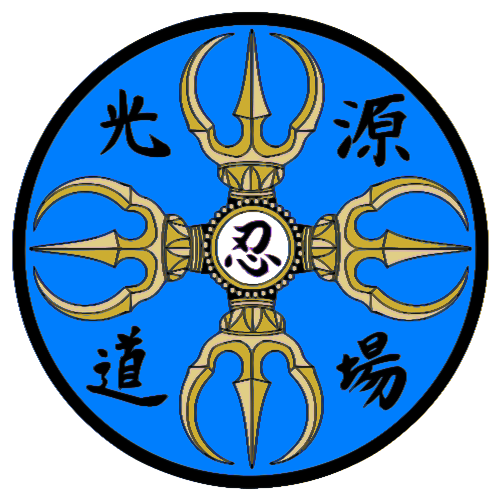
The emblem selected for Kogen Ninpo Dojo holds significant meaning and serves as a symbol for students to display on their Do-gi (training uniforms). This emblem features a distinctive twelve-point Vajra, which carries a profound esoteric significance and is believed to offer protection to students from evil spirits.
At the heart of the emblem is a crossed twelve-point symbol referred to as a Katsuma Sho, or karma vajra cross. This symbol is constructed from two crossed three-pronged vajras. These vajras represent the three secrets of body, speech, and mind. When these elements are united, the emblem signifies the harmony between the three secrets of the Buddha and the practitioner.
The twelve prongs of the Vajra further symbolize the twelve links of karmic causation. Through transformation, these links become the twelve causes of perfect enlightenment, reflecting the deeper teachings and aspirations within the dojo.
Encircling the cross is the dojo’s name, rendered in kanji. This is intended to represent protection from evil influences in every direction, reinforcing the emblem’s role as a spiritual safeguard for all members.
At the center of the symbol is the “Nin” character, which stands for perseverance and patience. This central element serves as a constant reminder to students to pursue enlightenment with dedication and resilience.
Sensei Corder’s Purpose and Dojo Traditions
Preserving and Sharing Ninpo Taijutsu
Sensei Corder is dedicated to teaching the traditional arts of Ninpo Taijutsu, with a commitment to sharing its benefits with students from diverse backgrounds. A central tenet of training at the dojo is the importance of humility; all students are encouraged to set aside their egos when entering the training space. As Sensei Corder states, “We are all students and can learn from each other no matter the status or rank.” This philosophy promotes mutual respect and continuous learning among all members of the dojo.
Passing Down Traditions
Sensei Corder’s goal is to ensure that the traditions of Ninpo Taijutsu are preserved and transmitted to future generations. By fostering a culture rooted in the values and techniques of the art, he seeks to keep these practices alive for years to come. The experience of studying Ninpo has had a profound impact on Sensei Corder himself, awakening within him the spirit of Budo that guides his teaching and leadership.
History and Membership
Kogen Ninpo Dojo was established on March 18, 2004, though Sensei Corder’s martial arts journey began in 1981. He started teaching Ninpo Taijutsu in 1989, drawing on his years of training and experience. Every student is provided with a membership book to document their achievements and record their annual fees. All Kogen Ninpo Dojo schools recognize ranked promotions from other branches, if students maintain their payments and remain in good standing within their local dojo or group. For those who relocate, their training and rank continue without interruption at their new branch.
Upholding Tradition and Values
To maintain continuity and protect the integrity of the tradition, Sensei Corder prohibits the teaching of different katas or techniques at branch schools. He insists on upholding the basic patterns and core values that have shaped his path: Honesty, Honor, Fidelity, Effort, Interest in all things, and Compassion. These guiding principles are central to the culture of Kogen Ninpo Dojo and are passed on to every student who trains under Sensei Corder’s guidance.
Student Selection and Instructor Qualification
Sensei Corder is highly selective in admitting new students to the dojo. He intentionally limits class sizes, accepting only a small number of students at any given time. This careful approach ensures that each student receives focused, high-quality instruction and fosters a close-knit learning environment. Sensei Corder strongly believes that it is far more valuable to work closely with a few dedicated students and instructors than to oversee large groups of students whose commitment may be less profound. This emphasis on quality over quantity is also a driving factor behind the establishment of branch dojo locations across the globe, allowing the core values and traditions of the arts to be maintained wherever they are taught.
Becoming one of Sensei Corder’s instructors is a significant achievement, requiring dedication and long-term commitment. To qualify for this role, a candidate must have trained directly under Sensei Corder’s guidance for a minimum of five years. For students who train at other locations, the dojo offers seminar opportunities, which can be arranged either at the student’s location or at the Honbu (main school), ensuring that all instructors remain closely connected to Sensei Corder’s teaching and standards.